
- Patna Centre
- More Centres are coming soon
- Offline Courses
- Patna Centre
- More Centres are coming soon
- Patna Centre
- More Centres are coming soon
- Offline Courses
- Patna Centre
- More Centres are coming soon
Blog
- Home
- Blog

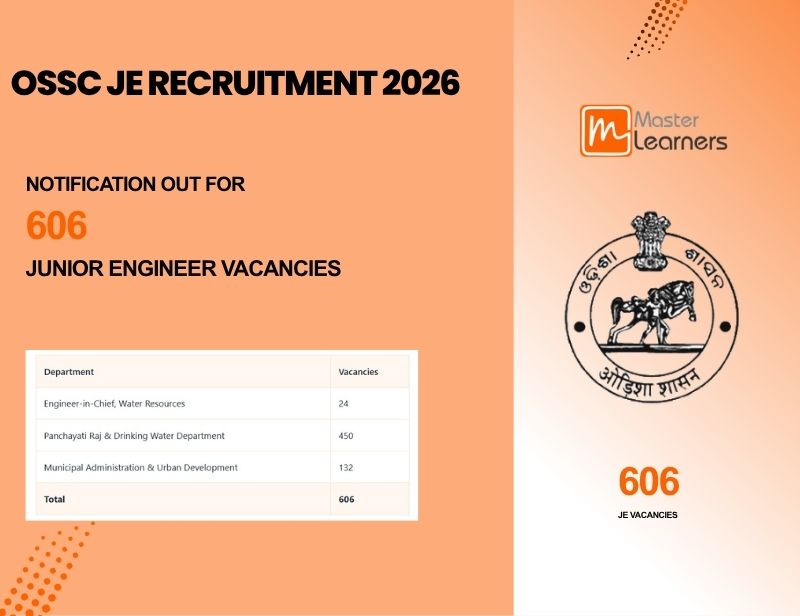
OSSC JE Recruitment 2026 Notification Released for 606 Junior Engineer Posts
Odisha Staff Selection Commission (OSSC) has officially announced 606 vacancies for Junior Engineer posts under various Odisha Government departments through CTSRE-2025 Recruitment.
OSSC JE Recruitment 2026 Overview
Check all important details including vacancy, salary, eligibility, exam pattern, application dates, and selection process.
| Particulars | Details |
|---|---|
| Organization | Odisha Staff Selection Commission (OSSC) |
| Exam Name | CTSRE-2025 |
| Post Name | Junior Engineer (JE) |
| Total Vacancies | 606 |
| Application Mode | Online |
| Qualification | Diploma in Civil Engineering |
| Age Limit | 21 to 42 Years |
| Selection Process | Prelims, Mains & Certificate Verification |
| Salary | ₹53,100 – ₹1,67,800 |
OSSC JE 2026 Important Dates
| Event | Date |
|---|---|
| Online Registration Starts | 30 May 2026 |
| Last Date to Register | 29 June 2026 |
| Last Date to Submit Application | 02 July 2026 |
| Application Editing Window | 05 July 2026 |
OSSC JE Vacancy 2026 Department Wise
Out of 606 vacancies, 202 posts are reserved for women candidates.
| Department | Vacancies |
|---|---|
| Engineer-in-Chief, Water Resources | 24 |
| Panchayati Raj & Drinking Water Department | 450 |
| Municipal Administration & Urban Development | 132 |
| Total | 606 |
OSSC JE Eligibility Criteria 2026
Educational Qualification
- Diploma in Civil Engineering from a recognized institution
- Institution approved by SCTE & VT Odisha or Directorate of Technical Education Odisha
Age Limit
- Minimum Age: 21 Years
- Maximum Age: 42 Years
Nationality
- Candidate must be a citizen of India
- Must be able to read, write and speak Odia language
OSSC JE Application Fee 2026
| Category | Application Fee |
|---|---|
| SC / ST / PwD / Women | Exempted |
| Other Categories | ₹500 |
OSSC JE Selection Process 2026
Stage 1
Preliminary Examination with objective questions.
Stage 2
Technical Main Written Examination.
Stage 3
Certificate & Document Verification.
OSSC JE Exam Pattern 2026
Preliminary Examination
- Objective Type Questions
- Total Marks: 100
- Duration: 150 Minutes
- Negative Marking Applicable
Main Examination
- Technical Subject Paper
- Total Marks: 200
- Duration: 3 Hours
OSSC JE Salary 2026
Selected Junior Engineers will receive attractive Pay Level-9 salary along with government allowances and benefits.
₹53,100 – ₹1,67,800
+ Dearness Allowance + HRA + Medical Benefits + Government Job Security
OSSC JE Syllabus 2026
The OSSC JE Civil Engineering syllabus includes major diploma-level technical subjects.
Why OSSC JE 2026 is a Great Opportunity?
Ready to Crack OSSC JE 2026?
Prepare with expert faculty, live classes, mock tests, previous year papers, and complete study material specially designed for AE/JE aspirants.
 Master Learners
RRB JE 2025–26 CBT 1 Exam Schedule Announced: Complete Guide for Aspirants
The RRB JE 2025–26 recruitment has reached a crucial phase with the announcement of the CBT 1 examination dates. Conducted by the Railway Recruitment Boards, this recruitment drive opens the door for engineering diploma and degree holders to secure technical positions in Indian Railways. With revised vacancy details and a confirmed exam timeline, aspirants must now focus on structured revision and exam readiness.
This blog by Master Learners Coaching explains all key aspects of the RRB JE 2025–26 recruitment in a simple and exam-oriented manner.
RRB JE CBT 1 Exam Date 2026 (Official Update)
The Railway Recruitment Boards have confirmed the CBT 1 exam dates for Junior Engineer and allied posts under CEN No. 05/2025.
CBT 1 Exam Dates
- 19 February 2026
- 20 February 2026
- 3 March 2026
The examination will be conducted in online mode across multiple centres and shifts. Candidates should regularly monitor their regional RRB website for admit card and shift-related updates.
RRB JE 2025–26 Notification Highlights
The RRB JE Notification 2025–26 provides detailed information on recruitment for technical posts such as:
- Junior Engineer (JE)
- Depot Material Superintendent (DMS)
- Chemical & Metallurgical Assistant (CMA)
- Research-level Chemical and Metallurgical Supervisors
Revised Vacancy Count
Total Vacancies: 2,569 (after official revision)
Vacancy numbers were updated through a corrigendum for select railway zones. Final post-wise distribution is available in the official notification.
Join Master Learners Online Course
RRB JE 2025–26 Important Dates at a Glance
|
Activity |
Timeline |
|
Short Notice Issued |
September 2025 |
|
Online Application Window |
31 Oct – 10 Dec 2025 |
|
CBT 1 Exam |
Feb–Mar 2026 |
|
Admit Card |
To be announced |
|
CBT 2 Exam |
To be announced |
Eligibility Criteria for RRB JE 2025–26
Educational Requirement
Applicants must possess a Diploma or Engineering Degree in the relevant discipline as prescribed for the post. Certain roles such as IT and CMA have specific qualification requirements.
Age Criteria
- Lower Age Limit: 18 years
- Upper Age Limit: 33 years
Relaxation in the upper age limit is applicable for reserved categories according to government norms.
Nationality
Candidates must fulfill the nationality conditions laid down by Indian Railways and the Government of India.
RRB JE Selection Process Explained
The recruitment process is conducted in multiple stages to ensure fair assessment:
- CBT 1: Screening test covering aptitude and basic awareness
- CBT 2: Technical examination focusing on core engineering subjects
- Document Verification: Validation of eligibility documents
- Medical Examination: Fitness assessment as per railway standards
Only candidates qualifying each stage move forward in the process.
RRB JE Exam Pattern 2026
CBT 1 Structure
- Mode: Online (CBT)
- Questions: 100 objective-type
- Time: 90 minutes
- Negative Marking: 1/3 mark per wrong answer
Sections Covered:
Mathematics, Reasoning, General Awareness, and General Science
CBT 2 Structure
- Mode: Online (CBT)
- Questions: 150 objective-type
- Time: 120 minutes
- Negative Marking: 1/3 mark per wrong answer
Focus Areas:
Technical abilities, general awareness, physics & chemistry, basic computers, and environmental studies
RRB JE Syllabus 2026 – Preparation Focus
The syllabus is designed to test both problem-solving ability and technical competence.
- CBT 1: Arithmetic, logical reasoning, current affairs, basic science
- CBT 2: Core engineering subjects based on diploma-level curriculum
At Master Learners Coaching, special emphasis is placed on technical subject mastery, as CBT 2 plays a decisive role in final merit.
RRB JE Salary and Benefits
Candidates selected as Junior Engineers are placed under Pay Level 6 of the 7th Pay Commission.
Pay Structure
- Starting Basic Pay: ₹35,400
- Pay Range: Up to ₹1,12,400
Additional Benefits
- Dearness Allowance
- House Rent Allowance or Railway accommodation
- Travel and medical benefits
- Pension and long-term job security
This makes RRB JE a highly attractive career option for engineering aspirants.
Admit Card, Answer Key & Result Updates
- Admit Card: Released a few days before the exam on regional RRB portals
- Answer Key: Published after the exam with objection facility
- Result: Released in PDF and scorecard format
Approximately 15 times the number of vacancies will be shortlisted from CBT 1 for CBT 2.
Preparation Guidance from Master Learners Coaching
With the exam dates confirmed, aspirants should now prioritize:
- Technical subject revision
- Mock test practice
- Time management improvement
- Accuracy and negative marking control
A structured preparation plan, expert guidance, and consistent practice can significantly improve performance in RRB JE 2025–26.
The announcement of the RRB JE 2025–26 CBT 1 exam schedule marks a decisive phase in the recruitment process. Candidates who prepare with focus and discipline in the coming months will have a strong edge in this competitive exam. Staying updated with official notifications and following a guided preparation approach is key to success.
Master Learners
SSC JE 2026 Exam: Notification Status, Tentative Schedule and Updates
The SSC JE 2026 examination is conducted to select Junior Engineers for Civil, Mechanical, and Electrical disciplines. As per the SSC Exam Calendar 2026, the official notification is likely to be released in March 2026, with the application window expected to remain open until April. The selection process consists of two written papers, and candidates must hold a relevant diploma or degree to be eligible.
SSC JE 2026 is a competitive government exam for candidates with a diploma or degree in Civil, Mechanical, or Electrical engineering. According to the SSC Exam Calendar, the notification is expected in March 2026, followed by the application window from March to April. The SSC JE 2026 exam is tentatively scheduled for May–June 2026. The official notification will provide details on eligibility, vacancies, syllabus, exam pattern, and the selection process, making it essential for aspirants to follow updates regularly and begin preparation early.
Join Master Learners SSC JE Courses
SSC JE 2026 Notification PDF – Expected in March 2026
The SSC JE 2026 Notification PDF is expected to be released online in March 2026 (tentative) on the official Staff Selection Commission website. The notification will provide complete details related to the SSC JE 2026 examination, including important dates, syllabus, exam pattern, vacancy details, and the online application procedure. Candidates are advised to go through the notification carefully to understand the eligibility conditions and other guidelines before submitting the application form. All official updates and instructions related to SSC JE 2026 will be available in the notification once it is released.
SSC JE 2026 Recruitment Overview
SSC JE 2026 is a national-level exam conducted by the Staff Selection Commission to recruit Junior Engineers in Civil, Mechanical, and Electrical disciplines for Central Government departments. The selection process includes two compulsory papers, both of which are considered for final selection.
SSC JE 2026 Exam – Key Highlights
- Exam Name: SSC JE 2026
- Post: Junior Engineer (Civil / Mechanical / Electrical)
- Conducting Body: Staff Selection Commission (SSC)
- Exam Mode: Computer-Based Test (CBT)
- Selection Stages: Paper 1 and Paper 2
- Job Type: Group B (Non-Gazetted) Central Government technical posts
Candidates should keep track of the SSC Exam Calendar 2026 and official SSC updates for the latest information.
SSC JE 2026 Vacancy Overview
The exact number of SSC JE 2026 vacancies will be announced in the official notification. Until then, candidates can refer to the previous year’s vacancy details to get a general idea of the expected intake. While the competition for SSC JE remains high, the number of available posts is usually substantial across engineering disciplines.
SSC JE Vacancy Trends
- SSC JE 2025: Around 1,731 vacancies (after revision)
- Posts were distributed across Civil, Mechanical, Electrical, and related engineering branches in various departments.
- SSC JE 2026: To be announced
- Vacancy figures are expected to follow a similar pattern, with final numbers confirmed only through the official notification.
Candidates are advised to rely on the official SSC notification for accurate vacancy details once released.
SSC JE 2026 Important Dates
Keeping track of SSC JE 2026 important dates helps candidates manage application deadlines, exam preparation, and revision schedules effectively. The Staff Selection Commission will announce the final schedule through the official SSC JE 2026 notification. Until then, aspirants can refer to the tentative timeline based on the SSC Exam Calendar 2026.
SSC JE 2026 Tentative Schedule
- Notification Release: March 2026
- Online Application Window: March to April 2026
- Admit Card (Paper 1): Expected around April 2026
- SSC JE 2026 Paper 1 Exam: May–June 2026
- Paper 1 Result: To be announced
- Paper 2 Exam: Dates to be notified later
Candidates should regularly check official SSC updates, as all dates are subject to change until confirmed in the notification.
SSC JE 2026 Eligibility Criteria
Candidates planning to appear for SSC JE 2026 should review the eligibility conditions carefully before applying. The Staff Selection Commission generally follows similar rules each year for nationality, age limit, and educational qualifications. Applicants must hold a relevant engineering diploma or degree and meet the prescribed age criteria for the specific post.
Key SSC JE 2026 Eligibility Requirements
- Nationality:
Applicants must be Indian citizens or fulfill the nationality conditions specified by the Government of India. - Age Limit:
The upper age limit for most Junior Engineer posts typically ranges between 30 and 32 years, with age relaxations applicable to candidates from reserved categories as per government norms. - Educational Qualification:
Candidates should have a three-year diploma or a B.E./B.Tech degree in Civil, Mechanical, Electrical, or a related engineering discipline, depending on the post.
Candidates are advised to check the post-wise eligibility details mentioned in the official SSC JE 2026 notification before submitting the application form.
How to Apply for SSC JE 2026 Application Form
The SSC JE 2026 application process is expected to be conducted online from March to April 2026 (tentative) through the official SSC website. Candidates must complete the application carefully, as incorrect or incomplete details may lead to rejection. It is recommended to keep all required documents ready before starting the registration process.
Steps:
- Visit the official Staff Selection Commission website.
- Complete the one-time registration using basic personal details, a valid mobile number, and email ID, if not already registered.
- Log in using the registration credentials and access the SSC JE 2026 application form link.
- Enter personal, educational, and contact details as per official documents.
- Upload the required photograph and signature in the prescribed format.
- Pay the SSC JE 2026 application fee through the available online payment modes.
- Submit the form and download a copy of the final application for future reference.
Candidates should ensure that all information provided matches their documents before final submission.
SSC JE 2026 Application Fee
Candidates applying for SSC JE 2026 will be required to pay the application fee through online modes such as debit card, credit card, net banking, or other payment options provided during form submission. The application fee structure generally follows a standard pattern, with concessions available for certain categories as per government norms.
SSC JE 2026 Expected Application Fee Structure
- General / OBC (Male): ₹100
- SC / ST / PwD: Fee exemption or reduced fee, as applicable
- Female Candidates: Usually exempted from payment, subject to official notification
Applicants are advised to verify the exact fee details in the official SSC JE 2026 notification, as the final fee structure may be revised.
Documents Required for SSC JE 2026 Application
Candidates should keep all necessary documents ready before filling out the SSC JE 2026 application form. Details entered in the form and uploaded documents must match the information provided in official certificates to avoid discrepancies at later stages.
Commonly Required Documents
- Recent passport-size photograph and scanned signature in the prescribed format
- Class 10 certificate for date of birth verification
- Diploma or Degree certificates and mark sheets in the relevant engineering discipline
- Category certificate (SC/ST/OBC/EWS), if applicable
- PwD certificate for candidates claiming disability reservation
- Valid photo identity proof such as Aadhaar card, PAN card, Voter ID, or Passport
SSC JE 2026 Selection Process
The SSC JE 2026 selection process will be detailed in the official notification and is expected to follow the standard structure used in previous years. Candidates must clear multiple stages to secure final selection, making it important to understand the exam pattern and syllabus in advance.
Stages of SSC JE 2026 Selection
- Paper 1: Computer-Based Test with objective-type questions
- Paper 2: Second-stage examination conducted in CBT mode for the chosen technical discipline
- Document Verification: Verification of original documents for shortlisted candidates
- Final Merit List: Prepared based on marks obtained in Paper 1 and Paper 2, along with category-wise rules
Candidates are advised to prepare strategically for both papers and keep documents organized for smooth verification.
SSC JE 2026 Exam Pattern
Understanding the SSC JE 2026 exam pattern is essential for effective time management and subject-wise preparation. The examination is conducted in two stages. Paper 1 focuses on objective-type questions, while Paper 2 is technical in nature and carries higher weightage. Candidates should refer to the official notification for the latest marking scheme and exam instructions.
SSC JE 2026 Exam Structure
- Paper 1
- Mode: Computer-Based Test (CBT)
- Subjects: General Intelligence & Reasoning, General Awareness, and Technical (Civil / Mechanical / Electrical)
- Total Marks: 200
- Duration: 2 hours
- Paper 2
- Mode: Computer-Based Test (CBT)
- Subject: Technical discipline chosen by the candidate
- Total Marks: 300
- Duration: 2 hours
Negative marking is applicable for incorrect answers, as per the rules mentioned in the official notification.
SSC JE 2026 Syllabus
The SSC JE 2026 syllabus is based on the official SSC Junior Engineer syllabus and covers both non-technical and technical subjects. The syllabus is designed to assess basic aptitude along with core engineering knowledge.
SSC JE 2026 Syllabus Overview
- General Intelligence & Reasoning:
Topics include verbal and non-verbal reasoning such as analogies, series, coding-decoding, classification, and problem-solving. - General Awareness:
Questions are asked from current affairs and general topics including Indian history, geography, polity, economy, and basic science. - Technical Subjects (Civil / Mechanical / Electrical):
Covers core engineering concepts as per diploma or degree-level standards, detailed in the official SSC JE syllabus PDF.
Candidates are advised to download the latest SSC JE syllabus PDF from the official SSC website and prepare a topic-wise study plan for better coverage.
SSC JE 2026 Result
The SSC JE 2026 result will be published online on the official website of the Staff Selection Commission. Results for each stage of the examination will be released separately in PDF format, listing the roll numbers of qualified candidates along with category-wise cut-off marks.
Initially, the Paper 1 result will be declared, and only candidates who qualify will be eligible to appear for Paper 2. After the completion of Paper 2 and document verification, SSC will release the final result and merit list, which will determine the final selection for Junior Engineer posts.
Candidates are advised to regularly check the official SSC website for result updates and cut-off details.
SSC JE Salary 2026
The SSC JE 2026 salary is governed by Central Government pay rules for Group B (Non-Gazetted) Junior Engineer posts. Selected candidates are usually placed under Pay Level 6 of the 7th Pay Commission, along with applicable allowances.
The in-hand salary includes basic pay along with benefits such as Dearness Allowance (DA), House Rent Allowance (HRA), Travel Allowance (TA), and other admissible allowances based on the posting location. Due to job stability, steady career growth, and government benefits, SSC JE remains a preferred career option for engineering diploma and degree holders.
Preparation Support for SSC JE Aspirants
Master Learners Coaching provides a structured and exam-oriented preparation approach for SSC JE 2026 aspirants. The course is designed to cover the complete syllabus through topic-wise lectures, detailed study material, regular practice questions, and mock tests aligned with the latest exam pattern. Emphasis is placed on strengthening core technical subjects along with systematic revision to help students build accuracy and confidence. With guided preparation and continuous assessment, Master Learners Coaching supports aspirants in improving their performance in SSC JE and other AE/JE engineering examinations.
Master Learners
The Rajasthan Subordinate and Ministerial Service Selection Board (RSMSSB) has published the official notification for the recruitment of Junior Engineers (JE) on 26th November 2024. This recruitment drive is aimed at filling 1100 JE vacancies across various government departments in Rajasthan. The application process has started from 28th November 2024, and eligible candidates can apply online through the official website at RSMSSB website. Here, we outline the key information including important dates, eligibility criteria, exam pattern, and more.
RSMSSB JE Recruitment 2024: Overview
The recruitment process includes a written examination followed by document verification. Below is a summary of key details related to the recruitment.
| Feature | Details |
|---|---|
| Organization | Rajasthan Subordinate and Ministerial Service Selection Board (RSMSSB) |
| Post Name | Junior Engineer (JE) |
| Total Vacancies | 1100 |
| Application Mode | Online |
| Application Period | 28th Nov to 27th Dec 2024 |
| Selection Process | Written Test & Document Verification |
| Salary | Pay Level 10 |
| Official Website | RSMSSB Website |
Important Dates
Below are the crucial dates for the RSMSSB JE 2024 recruitment process:
| Event | Date |
|---|---|
| Notification Release | 26th November 2024 |
| Application Start Date | 28th November 2024 |
| Last Date to Apply | 27th December 2024 |
| Admit Card Release | Last Week of January 2025 |
| Exam Dates | 6th to 11th and 22nd February 2025 |
Vacancy Details
The 1100 JE vacancies are distributed across several departments including Public Works, Water Resources, Public Health Engineering, and others. The detailed breakdown of vacancies across these departments is available in the official notification.
Application Process
Interested candidates can apply online via the RSMSSB official portal. It is advised to complete the application process well before the deadline to avoid last-minute technical issues.
Application Fee
Candidates are required to pay a non-refundable application fee based on their category:
| Category | Application Fee |
|---|---|
| General/OBC/EBC (CL) | Rs. 600/- |
| OBC/EBC (NCL)/EWS/SC/ST/PD | Rs. 400/- |
Eligibility Criteria
To be eligible for the Junior Engineer post, candidates must meet both educational qualifications and age requirements:
-
Educational Qualification:
- JE Civil (Degree): Degree in Civil Engineering
- JE Civil (Diploma): Diploma in Civil Engineering
- JE Mechanical/Electrical (Degree/Diploma): Degree/Diploma in Mechanical or Electrical Engineering
-
Age Limit: Candidates must be between 18 and 40 years of age as of 1st January 2025. Age relaxations apply as per government regulations.
Exam Pattern
The written examination consists of objective-type questions and is divided into two sections:
- General Knowledge (Rajasthan Specific) - 40 Marks
- Engineering Subjects (Civil/Mechanical/Electrical) - 80 Marks
| Section | Marks | Duration | Mode |
|---|---|---|---|
| General Knowledge | 40 | 2 Hours | Offline |
| Engineering Subjects | 80 |
Syllabus Overview
The syllabus for the RSMSSB JE exam includes two major sections:
- General Knowledge (Rajasthan Specific): Covering Rajasthan's history, culture, geography, economy, and current affairs.
- Engineering Subjects: Based on the respective disciplines (Civil, Mechanical, or Electrical Engineering).
Salary and Benefits
Successful candidates for the Junior Engineer position will receive a competitive salary under Pay Level 10, along with allowances such as HRA, DA, and others.
| Component | Amount |
|---|---|
| Basic Salary | Rs. 29,100 – Rs. 1,04,400 |
| Grade Pay | Rs. 5,400 |
| Net Salary | Rs. 33,800 |
Important Points to Remember
- Ensure you meet all eligibility criteria before applying.
- Submit your application well before the deadline to avoid technical issues.
- Prepare thoroughly for the written exam by reviewing the detailed syllabus and exam pattern.
The Rajasthan Subordinate and Ministerial Service Selection Board (RSMSSB) has published the official notification for the recruitment of Junior Engineers (JE) on 26th November 2024. This recruitment drive is aimed at filling 1100 JE vacancies across various government departments in Rajasthan. The application process has started from 28th November 2024, and eligible candidates can apply online through the official website at RSMSSB website. Here, we outline the key information including important dates, eligibility criteria, exam pattern, and more.
RSMSSB JE Recruitment 2024: Overview
The recruitment process includes a written examination followed by document verification. Below is a summary of key details related to the recruitment.
Feature Details Organization Rajasthan Subordinate and Ministerial Service Selection Board (RSMSSB) Post Name Junior Engineer (JE) Total Vacancies 1100 Application Mode Online Application Period 28th Nov to 27th Dec 2024 Selection Process Written Test & Document Verification Salary Pay Level 10 Official Website RSMSSB Website Important Dates
Below are the crucial dates for the RSMSSB JE 2024 recruitment process:
Event Date Notification Release 26th November 2024 Application Start Date 28th November 2024 Last Date to Apply 27th December 2024 Admit Card Release Last Week of January 2025 Exam Dates 6th to 11th and 22nd February 2025 Vacancy Details
The 1100 JE vacancies are distributed across several departments including Public Works, Water Resources, Public Health Engineering, and others. The detailed breakdown of vacancies across these departments is available in the official notification.
Application Process
Interested candidates can apply online via the RSMSSB official portal. It is advised to complete the application process well before the deadline to avoid last-minute technical issues.
Application Fee
Candidates are required to pay a non-refundable application fee based on their category:
Category Application Fee General/OBC/EBC (CL) Rs. 600/- OBC/EBC (NCL)/EWS/SC/ST/PD Rs. 400/- Eligibility Criteria
To be eligible for the Junior Engineer post, candidates must meet both educational qualifications and age requirements:
-
Educational Qualification:
- JE Civil (Degree): Degree in Civil Engineering
- JE Civil (Diploma): Diploma in Civil Engineering
- JE Mechanical/Electrical (Degree/Diploma): Degree/Diploma in Mechanical or Electrical Engineering
-
Age Limit: Candidates must be between 18 and 40 years of age as of 1st January 2025. Age relaxations apply as per government regulations.
-
Exam Pattern
The written examination consists of objective-type questions and is divided into two sections:
- General Knowledge (Rajasthan Specific) - 40 Marks
- Engineering Subjects (Civil/Mechanical/Electrical) - 80 Marks
-
Section Marks Duration Mode General Knowledge 40 2 Hours Offline Engineering Subjects 80 Syllabus Overview
The syllabus for the RSMSSB JE exam includes two major sections:
- General Knowledge (Rajasthan Specific): Covering Rajasthan's history, culture, geography, economy, and current affairs.
- Engineering Subjects: Based on the respective disciplines (Civil, Mechanical, or Electrical Engineering).
-
Salary and Benefits
Successful candidates for the Junior Engineer position will receive a competitive salary under Pay Level 10, along with allowances such as HRA, DA, and others.
Component Amount Basic Salary Rs. 29,100 – Rs. 1,04,400 Grade Pay Rs. 5,400 Net Salary Rs. 33,800 Important Points to Remember
- Ensure you meet all eligibility criteria before applying.
- Submit your application well before the deadline to avoid technical issues.
- Prepare thoroughly for the written exam by reviewing the detailed syllabus and exam pattern.
Master Learners
Syllabus and Exam Pattern for UPPSC AE 2024
The Uttar Pradesh Public Service Commission is gearing up to release the official notification for recruiting Assistant Engineers across various positions on its official website. Prospective candidates are advised to review the UPPSC AE Syllabus 2024 to initiate their exam preparation effectively. The UPPSC AE Syllabus 2024, along with the Exam Pattern, provides detailed guidelines for the structure of the question paper. This piece elaborates on the UPPSC AE Syllabus 2024, giving candidates valuable insights into the syllabus particulars. For a comprehensive understanding of the topic-wise syllabus for the UPPSC Assistant Engineer Exam 2024, it is recommended to thoroughly read the entire blog.
An Overview of UPPSC Assistant Engineer 2024 Exam Syllabus
|
UPPSC AE 2024 Syllabus Overview |
|
|
Organization |
Uttar Pradesh Public Service Commission (UPPSC) |
|
Post Name |
Assistant Engineer (Civil, Mechanical, Electrical, Director, Electrical Security, Boilers & Others) |
|
Application Mode |
Online |
|
Category |
Engineering Jobs |
|
Marking Scheme |
3 marks for every right answer |
|
Negative Marking |
-1 for every incorrect answer |
Detailed Overview of UPPSC AE Syllabus 2024
Delving Deeper into UPPSC Assistant Engineer Exam 2024: A Comprehensive Overview of Syllabus Incorporating General Hindi, General Knowledge, and Specialized Technical Disciplines in Civil Engineering"
Strategically Mapping Your UPPSC AE Exam 2024 Preparation: A Prudent Approach to Align Your Study Schedule with the Comprehensive Syllabus. Candidates are Encouraged to Scrutinize the UPPSC AE Syllabus Prior to Commencing Their Preparation. The Detailed Topic-wise Breakdown of the UPPSC AE 2024 Syllabus is Provided Below for Your Thorough Understanding.
UPPSC AE Syllabus 2024 for General Hindi
The expected syllabus for the subject of General Hindi is given below
- Hindi Grammar
- Sentence Formation
- Reading Comprehension
- Synonyms and Antonyms
- Fill in the Blanks
- Error Detection, etc.
UPPSC AE Syllabus for General Awareness
The UPPSC AE Syllabus for General Awareness is given below for the proper understanding of the candidates:
- Indian Polity, Economy & Culture
- Current National and International Important Events
- Indian Agriculture, Commerce & Trade
- Population, Ecology & Urbanization
- General Science
- Culture and Traditions of Uttar Pradesh
- History of India
- World Geography & Indian Geography & Natural Resources of India
- Indian National Movement
- Logical Reasoning
- Basic elementary mathematics
UPPSC AE Civil Engineering Syllabus
The important topics of the UPPSC AE Civil Engineering Syllabus 2024 is given below:
- Constructions Materials
- Surveying and Measurement
- Mechanics of Solids
- Structural Analysis
- Transport Phenomenon
- Engineering Economy & Management
- Elementary Engineering
- Energy Conversion
- Environmental Engineering
- Structural Design
- Hydrology and Water Resources Engineering
- Soil Mechanics and Foundations Engineering
- Design of Hydraulic Structure
- Fluid Mechanics and Open Channel Flow
- Transportation Engineering
- Hydraulic Engineering
- Public Health Engineering
Exam Pattern UPPSC AE 2024
The UPPSC AE Recruitment process unfolds in a two-tier structure: Prelims and Mains, culminating in a Personal Interview round for qualified candidates. Those who clear the written examination move on to the interview phase. The written exam, conducted in two shifts on the same day, consists of two papers. Paper I encompasses 125 questions, featuring 25 questions on General Hindi and 100 questions from the technical intricacies of the respective Engineering Branch. Similarly, Paper II comprises 125 questions, incorporating 25 questions on General Knowledge and 100 questions delving into the technical domain. For a more comprehensive understanding, the detailed UPPSC AE Exam Pattern and marking scheme for both Paper I & II are meticulously outlined below.
UPPSC AE Paper I Exam Pattern
Key Highlights of UPPSC AE Paper I Exam Pattern:
- Duration: The total time allocated for UPPSC AE Paper I is 2.5 hours.
- Question Count: A total of 125 questions will be included in the paper.
- Marking Scheme: As per the examination's marking system, candidates receive +3 marks for each correct answer and incur a penalty of -1 for each incorrect response.
- Question Domains: The questions will cover both General Hindi and the Technical Domains specific to the engineering branch chosen by the candidate.
|
UPPSC AE Paper I Exam Pattern |
|||
|
Subject |
No. of Questions |
Maximum Marks |
Time Duration |
|
General Hindi |
25 |
75 |
2 Hours 30 Minutes |
|
Concerned Engineering Subject Paper 1 |
100 |
300 |
|
|
Total |
125 |
375 |
|
UPPSC AE Paper II Exam Pattern
Salient Features of UPPSC AE Paper II Exam Pattern:
Duration: UPPSC AE Paper II has a duration of 2.5 hours.
Question Count: The paper comprises a total of 125 questions.
Marking Scheme: Candidates are awarded +3 marks for every correct answer and face a deduction of -1 for each incorrect response.
Question Domains: The questions encompass both General Studies and the Technical Domain specific to the engineering branch chosen by the candidate.
|
UPPSC AE Paper II Exam Pattern |
|||
|
Subject |
No. of Questions |
Maximum Marks |
Time Duration
|
|
General Studies |
25 |
75 |
2 Hours 30 Minutes |
|
Concerned Engineering Subject Paper 2 |
100 |
300 |
|
|
Total |
125 |
375 |
|
UPPSC AE Personal Interview Stage
The Commission is set to conduct personal interviews for candidates successfully clearing both Paper 1 and Paper 2. The interview aims to assess candidates' academic knowledge, personality, and general understanding. Following the interview process, the commission will release the final merit list of all selected candidates on its official website.
Enroll for State AE/JE Offline Course today and unlock your true potential and pave the way for a successful career. Find out more details at https://masterlearners.in/centre/patna
Master Learners
A choice cum preference from SSC has been released for Junior Engineer has been uploaded on https://ssc.nic.in/ on April 28, 2023 and this option can pave the way for a better career option for many candidates. However, the timing of this option poses a challenge for the candidates, as the SSC-JE Mains result is yet to be declared.
This option has made the candidates think and panic at the same time because hasty decision may jeopardize their right and if not exercised diligently candidate may chose wrong career for themselves.
The organizations which were listed in SSC JE notifications are as follows for SSC JE Civil Engineering aspirants.
|
S. No. |
Organization |
Post |
|
1 |
Border Roads Organization (BRO) |
Junior Engineer (Civil) |
|
2 |
Central Public Works Department (CPWD) |
Junior Engineer (Civil) |
|
3 |
Central Water and Power Research Station |
Junior Engineer (Civil) |
|
4 |
Central Water Commission |
Junior Engineer (Civil) |
|
6 |
Farakka Barrage Project (FBP) |
Junior Engineer (Civil) |
|
7 |
Military Engineer Services (MES) |
Junior Engineer (Civil) |
|
8 |
National Technical Research Organization (NTRO) |
Junior Engineer (Civil) |
|
9 |
Ministry of Ports, Shipping & Waterways (Andaman Lakshadweep Harbour Works) |
Junior Engineer (Civil) |
Note: Central Water Commission has withdrawn their vacancies this year and it is not in the service list anymore, of SSC-JE 2022.
In this blog we present few tips and techniques which candidates should pay heed upon and we try to present information in such a way that help you in assimilating decent inputs prior you exercise the right to decide to order of preference.
- Be Fully Aware About the Department Allotment Process
It has been noticed in the past that invited number of candidates are generally more than the actual vacancy in every organizations and general acceptable ratio of the same is 1:1.7. It means there will be almost 2 candidates are invited for one position in all the organization. Do preliminary research of eligibility criteria in every department like what was the earlier cut-off, is there any specific medical conditions or not. Generally every department decides their cut off and in first round of interviews they close the position, second round of interview is very rarely conducted. - Medical conditions in Border Road Organization
In this particular organization physical fitness plays a pivotal role in your assesement and this is the reason it is considered as an additional qualification for candidates. They should possess the physical attributes which allows them to function at high altitude. So, it is advisable to go through the eligibility criteria especially medical section of this particular service because BRO conducts a medical examination of their own.
- Calculate Your Tentative Score and Choose accordingly
It is evident that the services which are listed above have decided their cut-off marks for candidates in past and who recruitment in past was based on overall score in written assessment. Presently, lot of tools are available which can help you to calcualte your own upcoming score and if you can depict your score accurately, then it is helpful for you to exercise your preference intelligently.
- Don’t Decide on the Basis of Popularity of Service Rather Introspect
Measure your own strength and weakness, and be intelligent while exercising the option, as mentioned above, it is being reiterated that service allotment will happen once only, and there will hardly be any further round of allotment, if happened once and If you haven't chosen the service based on your predicted score then it may happen that your name gets excluded in the shortlisted list of organizations. Every service has their own charm but it is not one size fits all, and while exercising the preference you popularity of organization should not be the sole criteria rather your fitting in is an essential parameter.
Forms will be available online from 04th to 6th May on https://ssc.nic.in/
Please keep on visiting https://masterlearners.in/blog/
Master Learners
SSC JE 2022 Answer key is out on https://ssc.nic.in/ . Response sheet comprises gives a clear demarcation between correct & incorrect options. Also, it shows that whether candidates attempt was correct or not. Unlike response sheet of other exams, you can calculate your exact marks and the variation will be restricted to the question which will be challenged.
Candidates are advised to login and check their response sheet. There is an objection window through which representation in respect of the tentative answer keys, if any, may be submitted on payment of Rs. 100/- per question challenged.
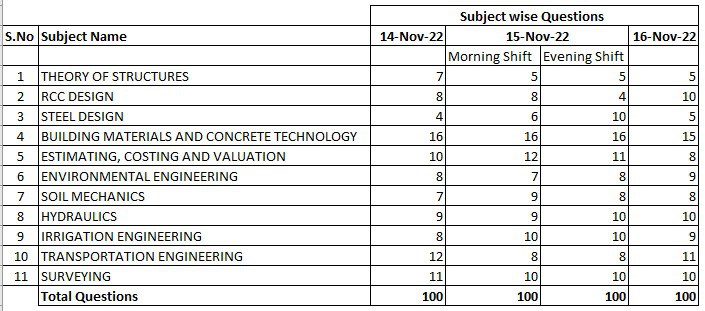
Candidates are advised to gauge their attempt thoroughly and as of now staff Selection board is silent for expected cut-off and it is to be released based of vacancy which is also not public as of now. The detailed analysis of the SSC-JE Civil Engineering question paper will be provided by our esteemed faculty members. Here is the breakup of subjectwise questions in various shifts of SSC-JE Paper-1.
Master learners SSC-JE Mains batch will be announced soon on https://masterlearners.in/
For more informative blogs like this, keep on visiting https://masterlearners.in/blog/
Master Learners
On 16th Nov. 2022 Public service commission, West Bengal issued advertisement no. 9/2022 on their website https://wbpsc.gov.in/advertisement.jsp. As need cropped up for services of junior engineer in various government department of Bengal, so government has invited online applications to recruit for various posts.
The vacancy details are yet to be notified and same will be announced by public service commission, west Bengal in consultation with government departments.
IMPORTANT DATES
|
S. No |
Particulars |
Date |
|
1 |
Commencement for submission of Online applications |
16th November, 2022 |
|
2 |
Closing date of Online Application |
07th December, 2022 |
|
3 |
Closing date of application through offline mode |
08th December, 2022 |
|
4 |
|
|
|
5 |
Calculation of Age limit for eligibility |
01st January, 2022 |
|
6 |
Domicile certificate date |
On or before the last date of application submission date. |
The advertisement no. 9/2022 comprises various detailed terms and conditions regarding eligibility, educational qualification, and fee of the examination. We have enumerated the important ones in easy and lucid language to convey the gist of this notification to students. Some important points from the notification are explained in this blog, read it and be aware. The detailed notification can be checked on
Age limit will be calculated as on 01.01.2022. The criteria of age limit have been categorized into two sections. One is for general category & other for various reserved categories.
|
S. No |
Categories |
Age limit |
|
1 |
General age |
36 |
|
2 |
Age for reserved category (SC & ST) |
5 Years relaxation & if person belongs to physically disabled category 7 Years. |
Qualification required:
Civil Engineering: Diploma in Civil Engineering from the State Council for Engineering and Technical Education, West Bengal, or its equivalent.
echanical Engineering: Diploma in Mechanical Engineering from the State Council for Engineering and Technical Education, West Bengal, or its equivalent.
Electrical Engineering: Diploma in Electrical Engineering from the State Council for Engineering and Technical Education, West Bengal, or its equivalent.
Scheme of Examination: The examination will consist of Objective type, Multiple choice questions. The question paper will be provided in English language only. Negative Marking will be there as per the notification.
How to submit the application
Application would be submitted in online mode only, and submission of more than one application leads to cancellation.
No. of Vacancies: Not clearly mentioned in the notification.
Syllabus For Written Test for Recruitment to The Post Of Junior engineers
Civil Engineering
- Strength Of Materials
Centre of gravity of plane figures, composite rectilinear figures, simple structural sections, M.I. of lamina, composite areas & of simple structural sections, simple stresses & strains, Characteristics of stress-strain curve for Mild Steel, S.F. and B.M. diagrams of loaded beams (fixed beam excluded), Bending & Shear stresses of beams, slope and deflection of cantilever and simply supported beams (point load & UDL), direct & bending stress, Eccentric loading on masonry pillars.
- THEORY OF STRUCTURES
Different types of frames-perfect, redundant & deficient, difference between statically determinate and statically indeterminate frames, Analysis of perfect frames, different methods (names only), Gravity structures – Dams & Retaining Walls (Rectangular & Trapezoidal sections), conditions of stability, Different types of failure of a Dam, Critical load on Columns – Euler’s, Rankine’s & B.I.S. Code formula.
Concrete Structures
Working stress method of design of simply supported R.C.C. rectangular beams (singly & doubly reinforced) and slabs (one way & two way), Cantilever slabs, singly reinforced T-Beams - Design of Reinforcements, Design of axially loaded R.C.C. short columns (square, rectangular & circular) by I.S. Code Formula, Isolated R.C.C. square footing of column, Basic Concept of pre-stressed concrete – Materials used.
Steel Structures
Design of rivetted joints, Failure of rivetted joints, Eccentric rivetted connections (brackets), Design of rolled steel beams in flexure & shear for a given load, design of axially loaded columns using standard rolled I-sections with or without plates, Design of simple truss.
Timber Structures
Design of simple structures.
3. CONSTRUCTION MATERIALS & PRACTICE
BUILDING MATERIALS
Bricks – Traditional & Modular, Size & Weight, I.S. Classifications, Testing of Bricks, Mortar & Concrete – different types, Usual proportions, Specific uses, Slump of concrete, Recommended values of slump for various works, Water-Cement ratio – its effect on strength of concrete, Curing of concrete, Sources and uses of stone, Sand & lime, Mosaic Tiles & Roof Tiles, Period of curing timbers, Commonly used timber in engineering works & their specific uses, Uses of plywood, Laminated Board, Block Board, Particle Board, Expanded metal, Polymer, Plain & Frosted glass, Paints & Varnishes.
CONSTRUCTION
Foundation, Object, Shallow & Deep Foundation, Names of different types, their uses in specific locations, Brick Masonry works, General principles & precautions, reinforced brick work, its advantages, damp proofing – materials used, causes & effect of dampness, roofs and roof coverings – different types – uses at specific locations, flooring, doors & windows – different types – uses at specific locations, Stairs, different types (names only), their uses at specific locations, requirements of a good stair as per N.B.C., Scaffolding, Shoring, Underpinning, Formwork – materials used, characteristics of good formwork, rules for removal of formwork, Common construction equipments.
4. FIELD SURVEYING
Metric surveying chain, types – different types, uses, Triangulation and Traversing, Tie line, Check line & Base line offsets – different types, Field book entry, Right angle setting in field with instruments and with chain or tape.
Compass – different types, uses, bearing, W.C.B. & R.B., Fore & Back bearing, Local attraction, Declination, Dip, closing error of a compass traverse, causes, adjustment, permissible error in compass surveying.
Plane Table survey – suitability, advantages & disadvantages, methods of plane tabling, equipments necessary. Levelling, types of level & leveling staff (names only), temporary adjustment of level, reduction of level, level book entry, reciprocal and profile levelling, correction for curvature & refraction, contouring, definition of contour, contour interval & horizontal equivalent, characteristics of contour lines, uses of contour map, methods of contouring (names only).
Theodolite Survey – different types of theodolites, important terms in connection with theodolite, uses of a theodolite, theodolite traversing, latitude & departure, closing error in a theodolite traverse, adjustments, permissible limits of error.
Curve setting – degree & radius of a curve, their inter-relation, elements of a simple curve, classification of curves.
5. Estimating, Costing & Contracts
Specification of works and materials, Estimates, different Types, general items of works, Units of measurement for building works as per B.I.S. Code, method of measurement for different items of work and materials, present market rates of materials & unit rate of items of work, floor area, carpet area and plinth area, F.A.R., Rate analysis – factors governing it, schedule of rates, analysis of rates for different items of works of a building.
Contracts – different types, Contract documents, submission & opening of Tender, earnest money, security deposit, measurement book, work order book, imprest and temporary advance, material at site account, suspense account.
Valuation, functions of a Valuer, factors affecting the value of a property, value & cost, scrap value, salvage value, assessed value,
speculative value, sinking fund, depreciation.
6. PUBLIC HEALTH ENGINEERING
WATER SUPPLY
Sources of water, ground water (springs, infiltration galleries & wells), Acquifer, Tube-wells – methods of boring, development of Tube-well, determination of tube diameter, length and diameter of a strainer, Motor & Hand Pump. Water requirements per capita demand, domestic, industrial & fire demands, population forecast. Intake works & transportation of water, Purification of Water, Removal of Salinity, Arsenic & iron. Raw water and Treated Water Quality. Treatment of water – plain sedimentation, feeding and mixing of coagulants, flocculation devices & clariflocculators, filters – rapid & slow sand filters, removal of hardness, disinfections– methods & applications. Different Pipe materials, Distribution of Waters, different systems & their applications, different appurtenances of distribution systems, guiding regulations of service connections according to Bengal Municipal Act.
SANITARY ENGINEERING
Elementary knowledge of Water & Air Pollution and Control. Classification of waste, necessity of waste disposal, different systems of Transportation of sewage, Sewers – Types, Sewerage, Sewer appurtenances, laying of sewers, quantity of sewage – domestic, industrial, storm water & ground water infiltration, estimation of run off, time of concentration, characteristics of sewage – Physical & Chemical (e.g. pH, colour, odour, turbidity, BOD, COD, nitrogen, chloride), sewage treatment processes - aerobic & anaerobic treatment, sewage treatment units, activated sludge process, trickling filter, septic tank, Rural Sanitation, Solid Waste disposal methods.
7. IRRIGATION
PRINCIPLES OF IRRIGATION
Necessity & benefits of irrigation – its ill effects, types of irrigation systems, methods of irrigation – surface irrigation, sprinkler irrigation and sub-surface irrigation.
HYDROLOGY
Measurement of rainfall – Symon’s rain gauge, average rainfall over an area by arithmetical mean method, Thiessen polygon method and Isohyetal method, Run off - factors affecting it.
WATER REQUIREMENT OF CROPS
Duty, Delta and base period – their inter-relations, factors affecting duty, methods of improving duty, commanded area, capacity factor, time factor, outlet factor, crop ratio, overlap allowance.
CANALS
Classification of canals, canal linings – Types and advantages, different parts of irrigation canals – their functions, designs of canal sections for a given discharge (using Kennedy & Kutter’s formula), Design of canal sections by using Manning Formula, Canal structures.
WELL IRRIGATION
Shallow and deep wells, yield from a well, advantages & disadvantages of well irrigation.
TUBEWELL IRRIGATION
Piped Water Irrigation, Design of Pipelines, and losses.
CROSS DRAINAGE WORKS
Aqueduct, super passage, siphon aqueduct, level crossing.
HEAD WORKS
Object, layout and functions of head works, classification of dams, different types of earthen dams, causes of failure of earthen dams and safety measures, difference between weir, barrage, and dams.
FLOOD CONTROL
Methods of flood control, reservoirs, flood walls, channel improvements, floodways. Cause & effect of flood.
RIVER TRAINING WORKS
Objectives, different types, guide bank, spurs, groynes, pitching, revetment, rip-rap.
8. ROADS & HIGHWAYS
INTRODUCTION
Classification of rural (non-urban) & urban roads as per I.R.C., terrain classification as per I.R.C.
ROAD GEOMETRICS
Road alignment, vertical and horizontal curves. Cross-sectional elements, recommended land width for different classes of roads, recommended speeds, Camber-objective-recommended values of camber for different types of roads, Gradients for roads in different terrains, Grade compensation at curves on hill roads, super-elevation-objects, transition curves objects, sight distance, different types, perception time, brake-reaction time, lag time, lag distance. Equipments used in road construction.
EARTH WORK
Cutting, filling angle of repose, allowance for settlement, profile, benching, lead & lift, borrow pit & spoil bank.
CITY ROADS
Kerb & channel, pedestrian crossing, guide island, refuge island, traffic lane.
HILL ROADS
Retaining walls, breast walls, weep holes, catchwater drains, hair pin bend, cliff gallery.
ROAD AGGREGATES
Different types, requirements of good road aggregates, testing of road aggregates (names of tests & their objectives).
HIGHWAY CONSTRUCTION
Road structure, component parts, functions, soil stabilization methods, Road Drainage. Water bound macadam roads – materials required – advantages & disadvantages. Bitumen – sources – types, Asphalt, Tar. Bituminous Road Types – Surface dressing (single & double coat), Grouting (semi grout & full grout), premix type (premix chipping carpet, premix macadam & premix concrete) – Functions, constructions, quantities of materials required for each type. Cement concrete Roads : Pavement joints, necessity types, joint sealer, joint filler, dowel bar, tie bar, mud pumping,
Culverts & Bridges – differences – component parts – wing wall, Abutment and Piers. Classification of Bridges, Span, Flood discharge, Waterway, Scouring, Depth of Foundation, Clearance and Free Board, Maintenance of Bridges.
9. Soil Mechanics & Foundation Engineering
Classification of soil – Particle size – MIT & IS Sieve Analysis.
Index, properties of soil.
Phase diagram for dry, moist and saturated soil, Definition – void ratio, porosity, water content, degree of saturation, Unit weight,
Sp. Gr., Density, bulk density, dry density, submerged density, air content etc.
Consistency of soil – Moisture content & volume relationship, Definition – Atterberg Limit, plasticity index, density index shrinkage ratio.
Permeability of soil – Darcy’s law, coeff of permeability, factors affecting permeability.
Compaction – Dry density by Proctor’s compaction.
Consolidation – Difference between compaction & consolidation, compression index, coeff of compressibility, volume compressibility, coeff of consolidation, settlement of foundation.
Shear strength – Definition of shear strength and shear parameters.
Earth Pressure – Active and passive earth pressure, coeff of passive earth pressure – Rankine’s earth pressure theory, Angle of repose, pressure intensity diagram, Resultant thrust.
Foundations – Shallow & deep foundations, types of shallow foundation (names & uses only) types of deep foundation (names & uses only), Bearing capacity, Terzaghis bearing capacity formula, assumptions & problems, plate load test. Pile foundation –
formula related to pile foundation, Dynamic Engineering News formula, Hiley’s formula, static formula.
Soil Stabilization – Principles, types – Mechanical stabilization, cement stabilization, lime stabilization, bitumen, stabilization by grouting.
Soil exploration – Preliminary work – Site reconnaissance, trial pits, boring.
Types of soil samples – Procuring & handling of disturbed and undisturbed samples.
Presentation of soil investigation result.
10. Civil Engineering Drawing
Isometric view, Development of surface.
Aspirants from entire country can utilize this opportunity to fullest and can get themselves placed in various government departments. There are other national & state level vacancies are in pipeline and for more informative articles like these keep on visiting https://masterlearners.in/
Master Learners
On 11th Nov. 2022 Govt. of Jammu & Kashmir services selection board issued notification no. 6/2022 on their website https://www.jkssb.nic.in. This notification is issued based on indent received from public works department (R&B). The indenting department has raised the requisition to fill certain posts through a competitive examination wherein Jr engineers will be recruited. The details of the posts are as follows:
|
S. No |
Indenting Department |
No. of Posts received |
|
1 |
PWD (R&B) |
855 |
|
2 |
190 |
|
|
|
Total |
1045 |
IMPORTANT DATES
|
S. No |
Particulars |
Date |
|
1 |
Commencement for submission of Online applications |
21st November, 2022 |
|
2 |
Last date for submission of Online Application |
20th December, 2022 |
|
3 |
Calculation of Age limit for eligibility |
01st January, 2022 |
|
4 |
Domicile certificate date |
On or before the last date of application submission date. |
The notification comprises detailed terms and conditions regarding eligibility, educational domicile, and reservation. We have explained some important points from the notification in this blog, read it and be aware. The detailed notification can be checked on https://bit.ly/3Efw7oJ
Domicile certificate is necessary if an aspirant seeks to apply for this vacancy. It is clearly mentioned in the notification that candidate should be a domicile of the Union Territory of Jammu & Kashmir, so candidates from only J&K Union territory can apply for this vacancy.
Age limit will be calculated as on 01.01.2022. The criteria of age limit have been categorized into two sections. One is for Open merit & other is for various reserved categories.
|
S. No |
Categories |
Age limit |
|
1 |
Open Merit & Govt. service/Сontractual Employment |
40 |
|
2 |
Other reserved categories (SC, ST, EWS, etc..) |
43 |
Qualification required:
Civil Engineering: University degree in civil engineering or AMIE Section (A&B) INDIA or 03 years Diploma in Civil Engineering from Government recognized institute/Indian.
Mechanical Engineering: 3-years diploma in Mechanical Engineering from Government recognized institute/Indian university degree in Mechanical engineering or AMIE Section (A&B) INDIA. Indian University degree/ 03 years diploma from Government recognized institute in aeronautical/automobile production engineering
Scheme of Examination: The examination will consist of Objective type, Multiple choice questions. The question paper will be provided in English language only. Negative Marking will be of 0.25 Marks.
How to apply
The candidates are advised to check the website www.jkssb.nic.in regularly and application can be submitted from 21st November, 2022. This vacancy is announced on the pretext of indent raised by the PWD Department raised on 06th April, 2022 through indent number PWD-Adm/122/2021-(Comp.No.118431)
Aspirants from Jammu & Kashmir can utilize this opportunity to fullest and can get themselves placed in various government departments. There are other national & state level vacancies are in pipeline and for more informative articles like these keep on visiting https://masterlearners.in/
Master Learners
Aspirants can now download the admit card for SSC-JE 2022 exam which is scheduled to be conducted on 14-November-2022 to 16-November-2022. By following these simple steps admit card can be downloaded.
Steps to Download SSC JE Admit Card
- Browse the official website ssc.nic.in and click on the admit card option on the homepage.
- Select your region and the SSC JE Admit Card 2022 download link will be displayed.
- Click on the link and enter the required credentials (Roll Number and Date of Birth/ username and Password).
- The SSC JE Junior Engineer Hall Ticket 2022 Tier 1 appears in a separate window.
- Save and download the SSC Junior Engineer Exam 2022 Admit card for your reference.
Now excitement and thrill will take hold on the aspirant’s psyche and they will be on emotional rollercoaster till exam gets over. But the best utilization of this time will be to practice the questions religiously and make full use of your time.
We, Masterlearners team, launched Three [3] free full length online tests to help you brushing up your concepts. These tests will help you in getting hold on your concepts because in these 3 full length tests you will questions which are alike asked in the actual exam.
Don’t miss the opportunity, Enroll now using the URL https://bit.ly/3hoinQy for free.
For more useful study tools like, visit : https://masterlearners.in/
Master Learners
Whenever the exam approaches, it is obvious that the students will be worried, the constant mood swings and excitement will take hold of their thought process as the time to show their effort is near. Scientific researches have documented that in the process of exam preparation students are classified into different categories. Generally, two most famous category of students are found viz. Confident and worried. The first class is said to be a self-confident student because he left no stone unturned in his preparation and his confidence grew every day, his success seems obvious to all. Conversely the other category is called anxious, which consists of students who are not so sure about their preparation and find themselves in a dilemma whether they should appear in this attempt or will it be worth the foregoing & we should get ready for the next one. But despite the difference in their approach and category, their aim is the same and they are aiming only towards success in this exam.
Here are some tips which can be helpful for you to follow and you can utilize the last week before SSC-JE 2022 Prelims of exam preparation in the best possible way.
Maintain a balanced routine
It is the time to narrow your focus and develop a single pointed attention and adopting a steady routine will be of great help in achieving the same. Majority of the time will be devoted to studies in a day and when studies are supplemented with a proper routine in which activities for leisure, health, recreation gets included, output gets multiplied. So, it is advisable to keep a record for the daily activities and make sure that along with studies, recreational activities are also included, it will avoid the burnouts and keep you refreshed and energized for the upcoming exam.
Do not learn, only revise
Human mind takes time to internalize the knowledge and when your exams are near studying or learning something new will give you minimum output. Concretize your knowledge through revision, and make sure that any question comes from the topic which you have prepared thoroughly, should be attempted with utmost accuracy.
Make an effective study plan
As already mentioned above that now is the time to revise and whatever you have studied so far needs to be reproduced in the exam, if you plan your studies properly and keep note of the things mentioned below, your study plan will be meticulously designed.
- Pick out those subjects of which revision is already completed once.
- Make a combination of two subjects a day, and it is highly recommended that please pick out the subjects of which topics are interlinked e.g., if you are a student of civil engineering then you can make the combination of Strength of Material & Structure together.
- Stick to the practice of objective questions.
- Do not miss previous year questions, it is one of the most important study resources which students should be well versed with.
- Avoid ranking yourself based on your score in test series rather make improvements in your attempt ratio and accuracy ratio.
With these things you can utilize your last week with a balanced mindset. All exams are test of your practice more than the test of your knowledge. This is not a battle to win rather a game to stay in. Understand and measure your own preparation daily. You have worked hard and it cannot go in wain, whatever you have studied have faith in that and reproduce in the exam.
Master learners wishes you all the best for your upcoming SSC-JE 2022 prelims exam and for any kind of assistance, we can be reached on info@masterlearners.in.
Visit Master Learnes website masterlearners.in to check out the latest courses for various exams.
Master Learners
Preponement in date of conducting SSC-JE exams, is a topic of discussion for everyone because on 06th July, 2022 revised exam calendar (https://bit.ly/exam-calender) got uploaded on https://ssc.nic.in/. This pose a challenge for students because now students have only 4 months to prepare whereas duration was more than 6 months as per previous update on the website.
And key highlights of the notification are as follows:
|
SSC JE 2021-22 Important Dates |
|
|
SSC JE Application 2022 Start Date |
12th August 2022 |
|
SSC JE Last Day to Apply 2022 |
02nd September 2022 |
|
SSC JE Tier 1 Exam Date 2022 |
November 2022 |
|
Branches |
|
|
SSC Official Website |
www.ssc.nic.in |
Challenges and Opportunities
This preponement has a lot of bearing on aspirant’s preparation approach. There will be modifications in their study schedules, practice modes and priorities of subjects and when it comes to approaching a competitive exam within a short span of time, there are various approaches to prepare for this exam and detailed discussions are mentioned on Masterleaners youtube channel https://www.youtube.com/c/MasterLearners . This preponement also offers an opportunity to all those aspirants who have prepared well for exams from very beginning, because now they have to revise and compile all their learning in last three months. It is advisable for students to stick to the same material for their upcoming exams.
SSC-JE online course from Masterlearners can be a best companion for students who want to excel in this exam. Details of the courses are mentioned on https://masterlearners.in/ . Be ready to excel and stay tuned to get further updates related to SSC-JE and other competitive exams.
Master Learners
There is a myth prevalent about competitive exams which is that you have to study continuously for at least 6 to 8 hours but the fact of the matter is that you need to plan your studies and create an ideal study schedule beforehand to prepare well and give equal weightage to each and every subject. There is a systematic, well research study plan created by our academic experts to help students and achieve their dream result.
Here are few tips for how to create an ideal study schedule
- Emphasis on exam syllabus: Exam syllabus is one of the most important factors which students ignore but it is something which student cannot ignore and it plays a pivotal role in success or failure of the students.
- Trend Analysis: Decipher the trend of the exam, and identify the weightage attributed to each and every subject. This trend will become the basis of your preparation and you will plan your studies accordingly
- Prioritize: It is a proven fact that exams are not the test of your knowledge rather they are test of patterns. Now, you need don’t need to master each and every subject rather requisite knowledge of each and every subject is must for clearing the exams.
- Create a schedule: When you are done with all three above steps then you can create a study schedule and you need to stick to that. First and foremost, requirement is that you should stick to the schedule created by the institute wherein you have enrolled for your preparation. Coaching institute wherein you have enrolled for your preparation will create a schedule based on the vast experience they possess and also on the basis of interlinking among subjects. So, trust them completely and just follow everything which has been taught in the class.
- Cyclic revision plan: it is a well-known fact that merely covering of syllabus is not suffice to clear the exams rather a cyclic revision so that each and every concept studied in class gets revised on regular basis and never let any concept gets weaken.
- Practice smartly: Syllabus of SSC JE test your knowledge of theory & your ability to solve complex problems of each and every subject. Whenever you are planning a study- sitting make sure you have prepared a list of questions and concepts to be practice in the same. Sequence of the concepts and subjects is to be enlisted beforehand to align your study schedule with the coaching whom you are preparing with.
Creation of study schedule is an essence for the aspirant who is dreaming big for his life and few points are mentioned above and incorporating them in your study plans will help you in creating an ideal study schedule.
How Masterlearners can help you?
Online course crafted for SSC-JE is a perfect blend for theory as well as practical and it will help you in framing a sequence for the subjects. SSC-JE live online course is available on https://masterlearners.in/ and enrolling for the same will help you in forming a plan backed by the guidance of most reliable mentor in the field of engineering.
Master Learners
Learning and teaching are evolving on regular basis and in this digital era, influx of technology paved the way for aspirants to teach and learn in online mode. Teachers and learner can take the full advantage of digital tools to create a better learning outcome. In this article we would like to throw some light on use of online learning and will try to answer the question that whether E-learning can help you in clearing competitive exams like SSC-JE and what should be the best way to learn effectively. The learning and teaching have same methodology because job of teacher will always remain same viz. stimulate human mind and job of the learner will be to learn effectively. Some of the things which should be kept in mind for online learners are given below.
- Be tech-friendly
Aspirants should possess moderate knowledge of technology because in today’s time it is of great significance for anyone who is consuming any sort of content to access the content from the internet. Aspirant doesn’t need to be a pro-tech savvy to access the content but basic knowledge of technology used for providing the content will be helpful and it will helpful in learning more efficiently.
- Learn to use digital gadgets effectively
Here students need to understand that they are not sitting before their teacher rather they are connected with their teachers through Internet. So, the gadget through which they are learning plays a pivotal role in their learning graph. So, access device through which they are accessing the content carries lot of weight in learning the subject by heart.
- Avoid Information overload
Technology has created an opportunity for every one to share their content entails there are lot of teachers sharing their content free or by charging a nominal fee. Now, the students are unable to figure out that who should they choose as their learning partner. One subject is taught by more than one faculty and it is available on a public platform for free which causes an information overload for students. Competitive exams are a test of balanced knowledge of all the subjects and aspirants should put equal weightage to all the subjects by adopting a strategic learning and guiding method.
Here are the few tips to choose right learning partner for you
- Select a Mentor and stick to him till completion of the course.
- Maintain continuity in studies.
- Analyze the study material offered by the respective institute beforehand.
- Take review from someone who you trust.
follow these steps and you will end up taking intelligent decisions for your exams.
It is a fact that competitive exams require a different approach of preparation and conceptual clarity is must because then only they will be able to tackle the questions asked by the exam authorities. Now, since the competition is tough, choice of mentors & mode of teaching becomes a very important decision for students. Online mode has certain benefits like no travelling, learning from the comforts of their homes etc. but the most important aspect of this mode of learning offers is flexible learning approach.
Flexible learning approach
Whenever any aspirant start preparing for competitive exam, a flexible mode of learning will be more beneficial for students and this would help students in aligning their study schedule according to the needs of competitive exams. This flexibility is not available in offline mode of learning and for the competitive exams like SSC-JE where at least 500 hours of classroom guidance is must and if students have the access of the class videos as per the time of his convenience, then he can increase or decrease the pace of his learning according to his own schedule. One more benefit which it offers is that revision of the concepts through video by watching videos more than once. This way they can prepare and revise simultaneously through online videos and practice questions in the online format in which exams are conducted. So, if you are choosing online format to prepare for competitive exams then you are not on the wrong track provided you are following the tips mentioned in this article.
Role of Masterlearners in your preparation
Masterlearners is an online platform powered by IES Master wherein you will be getting customized courses for different competitive exams which are finetuned by our renowned faculty members and everyone is putting their strides in creating the courses which would benefit the students and they will be able to approach the competitive exams with a different vantage point. Details are available on https://masterlearners.in/ and for more updates keep on visiting https://masterlearners.in/blog
Master Learners
In India there are lot of opportunities available for an engineer but there is a fierce battle for a position which would earn a position of repute for an engineer. Junior engineer is a position which opens up a window for an engineer to perform techno-managerial role and stick to the core values of engineering profession. This position can be attained with the help of a competitive exam called SSC-JE conducted by Staff selection commission.
This year exam calendar has been updated on https://ssc.nic.in/ and the tentative exam for Paper-1 viz. computer-based exam is on 28th Nov. 2022. Vacancy for junior engineers is created almost every year by different ministries and this year according to the official notification is not announced but there is a hope that there is a surge in vacancies for engineers. The paper pattern for junior engineers judges the intrinsic value of an engineer by testing him through two tier exam patterns. One level is conducted as computer-based examination and other one is in paper-pen mode and in subjective form.
Aspirants who want to work with central government and see how a national level projects are being executed and developed by engineering community should definitely try this exam and contribute with their technical knowledge in developing the resources of this country. The best part for this year aspirant is that they have a companion to prepare with Masterlearners (an Initiative of IES Master).
Masterlearner has come up with SSC JE live online course for the aspirants of SSC-JE and this course is meticulously designed to uplift the preparation level of this year aspirants. Objective paper question bank of SSC-JE designed by IES Master is one of the most sought-after books for the aspirants since last 3 years. Students have admired the amicability of the book and its unique way of providing solution of complex problems. This course will uphold the expectation of the students and the quality which has been offered through its SSC-JE Objective question bank will be replicated in this online course. There are fine details for every exam and same needs to be pondered by the aspirants to excel in any competitive exam. The mentorship offered by Masterlearners is to infuse the interest for learning through its versatile teaching pedagogy and its 360-degree learning environment. Do check out this course on https://masterlearners.in/live-classes to begin your preparation with a bang and stay ahead in the competition.
Master LearnersRecent Posts
Master Learners
Studying for competitive exams is an art in itself, it requires a comprehensive approach for learners and it is very important now a days those aspirants groom themselves for competitive exams.
Resources
Explore

© 2022 Master Learners Proudly Crafted by IES Master
All rights reserved by IES Master Learners Pvt. Ltd.
